Sustainable Edge AI Infrastructure: Green Architecture Trends
Explore the critical role of sustainability in edge AI infrastructure with energy-efficient micro data centers and eco-friendly computing practices. This blog guides enterprise architects through architectural patterns, platform choices, data management, operational challenges, and compliance frameworks to design and operate green edge AI deployments at scale.
Introduction: The Imperative of Sustainability in Edge AI Infrastructure
As enterprises increasingly deploy AI workloads at the edge, sustainability emerges as a fundamental architectural imperative. Edge computing shifts data processing closer to the source to reduce latency and bandwidth but introduces new challenges in energy consumption, physical footprint, and environmental impact. According to industry reports, energy-efficient micro data centers and green computing practices are instrumental for 2025 and beyond to achieve sustainable AI deployments at the edge. These trends align with global ESG initiatives and regulatory pressures to reduce carbon emissions and operational costs.
Edge AI Growth and Sustainability Drivers
The surge of AI models deployed on edge devices—from retail kiosks to industrial IoT gateways—necessitates localized compute power that is energy efficient and modular. This shift compels enterprises to adopt micro data centers built using low-power processors, renewable energy, and advanced cooling technologies. Sustainable edge infrastructure not only minimizes environmental impact but also enhances resilience for AI applications under constrained connectivity or harsh conditions.
Emerging Architectural Considerations
- Modular Micro Data Centers: Compact, energy-optimized infrastructure units that support rapid deployment and easy scaling near the data source.
- Low-power AI Accelerators: Leveraging specialized ASICs and GPUs designed for high performance per watt.
- Renewable and Hybrid Energy Sources: Incorporating solar, wind, or grid energy optimized through smart management.
- Green Software Practices: AI model quantization, pruning, and efficient inference frameworks to reduce resource consumption.
By integrating these trends, enterprise architects can create edge AI systems that meet both performance and sustainability goals, balancing operational efficiency with ecological responsibility.
Sustainable Edge AI Systems: Data Architecture and Integration Patterns
Designing sustainable edge AI infrastructure involves holistic consideration of data flows, compute orchestration, and system integration while keeping energy efficiency at the forefront.
Data Architecture for Green Edge AI
Efficient data management is crucial to reduce energy-intensive data transfers and storage:
- Data Lakes and Edge Caches: Distributed data lakes localized at the edge to minimize round-trip data movement.
- Real-Time Stream Processing: Implement event-driven pipelines that filter and preprocess data onsite, sending only aggregated or critical data to central clouds.
- Data Governance and Lifecycle Management: Automate data retention and deletion policies to avoid unnecessary storage overheads.
Integration Patterns Supporting Sustainability
- Microservices and APIs: Lightweight containerized AI microservices orchestrated via Kubernetes clusters enable dynamic resource scaling minimizing idle compute.
- Event-Driven Architectures: Asynchronous communication via message queues reduces synchronous overhead and allows better utilization of compute resources.
- Hybrid Cloud-Edge Coordination: Utilize federated learning and model updates pushing computation intelligently between edge and cloud depending on energy costs and latency constraints.
Operational Data and Monitoring
Implement fine-grained telemetry to monitor power consumption at compute nodes, thermal metrics, and AI inference efficiency. Use AIOps platforms to optimize workload scheduling dynamically based on energy footprints and environmental conditions.
This integrated approach results in a sustainable data and system infrastructure that maximizes AI capabilities at the edge while pruning energy waste.
Architectural Recommendations for Sustainable Edge AI Deployment
To architect sustainable edge AI infrastructure, enterprises must adopt specific technology frameworks and governance models ensuring long-term efficiency and compliance.
Infrastructure and Platform Choices
- Cloud-Native Edge Platforms: Leverage solutions like AWS IoT Greengrass, Azure IoT Edge, or Google Distributed Cloud Edge that provide container orchestration, edge runtime environments, and integration with cloud sustainability services.
- Containerization and Orchestration: Kubernetes clusters with energy-aware autoscaling policies that spin up/down nodes based on real-time demand and power usage.
- AI Hardware Selection: Deploy low-power AI accelerators such as NVIDIA Jetson Xavier NX or Google's Edge TPU tailored for edge inferencing.
Security, Compliance, and Governance
Apply zero-trust security principles ensuring encrypted data flows and audited access, critical for distributed edge nodes.
Adhere to environmental compliance standards like ISO 14001 for environmental management and integrate sustainability KPIs into AI governance frameworks.
Organizational Impact and Operational Excellence
- Team Structures: Establish cross-functional teams combining AI engineering, infrastructure, and sustainability expertise.
- MLOps and Green AI Practices: Incorporate model lifecycle pipelines that prioritize resource efficiency, model compression, and iterative tuning.
- Continuous Monitoring and Optimization: Use analytics dashboards correlating AI workload analytics with energy consumption to identify optimization opportunities.
Diagram Concept
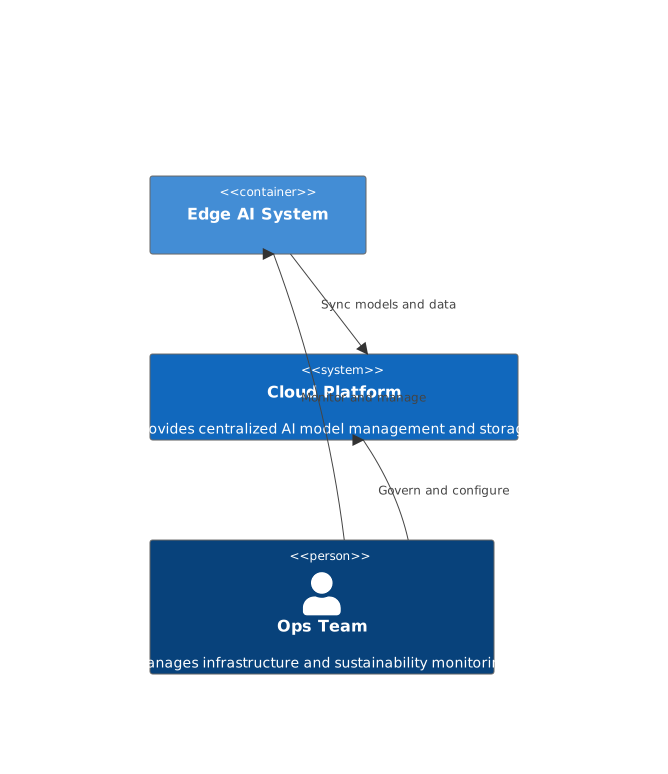
The architecture diagram illustrates hybrid cloud-edge AI deployment with interconnected micro data centers, orchestrated containerized AI services, renewable energy inputs, integrated security layers, and monitoring telemetry for energy and performance metrics.
By adopting these recommendations, enterprises can ensure scalable, secure, and energy-efficient edge AI deployments aligned with sustainability goals.

Further Reading
- https://www.zelladc.com/insights/top-edge-computing-trends-for-2025/
- https://onlinelibrary.wiley.com/doi/10.1002/spe.3340
- https://www.forbes.com/councils/forbestechcouncil/2024/12/12/2025-it-infrastructure-trends-the-edge-computing-hci-and-ai-boom/
- https://www.cncf.io/blog/2024/05/03/top-5-cloud-computing-trends-of-2024/
- https://www.digi.com/blog/post/how-edge-computing-supports-sustainability