Distributed Industrial Mesh Networks for Scalable AI
Explore how distributed industrial mesh networks using protocols like NATS enable scalable, low-latency edge AI in industrial automation. Understand architectural patterns, integration strategies, and governance practices critical for enterprise adoption of mesh-based AI-enabled industrial networks.
Introduction: The Rise of Distributed Industrial Mesh Networks for AI
Industrial automation increasingly demands real-time, scalable, and resilient communication networks for AI-driven decision-making at the edge. Distributed industrial mesh networks, facilitated by lightweight, high-performance pub-sub messaging protocols like NATS, have emerged as a key enabler for such low-latency, secure, and scalable industrial environments.
Industry Drivers and Architectural Trends
The key drivers behind adoption of distributed mesh AI architectures in industrial settings include:
- Edge-first AI processing: Minimizing cloud dependency to enable real-time control and analytics close to sensors and actuators.
- Scalability & resilience: Networks must gracefully scale to thousands of industrial devices without incurring bottlenecks or single points of failure.
- Decentralization & autonomy: Edge nodes require autonomous decision capabilities with peer-to-peer mesh communication to improve reliability.
- Security & governance: Industrial environments demand strict isolation, zero-trust security frameworks, and compliance with standards like ISA/IEC 62443 for operational technology.
Emerging Patterns
Enterprises are adopting cloud-native architectures involving:
- Microservices and event-driven integration deployed both in the cloud and at edge clusters.
- Containerized AI inference and streaming analytics workloads orchestrated via Kubernetes at edge data centers.
- Use of industrial message brokers such as NATS JetStream, adapted for edge-mesh to support long-lived durable event streams with low latency.
These trends are foundational for building real-time Industrial IoT (IIoT) systems capable of AI-driven predictive maintenance, quality control, and adaptive automation.
References:
- TechTarget edge computing trends (https://www.techtarget.com/searchcio/tip/Top-edge-computing-trends-to-watch-in-2020)
- CNCF blog on cloud-native mesh networks (https://www.cncf.io/blog/2023/04/18/developing-microservices-at-scale-using-cloud-native-mesh-networks/)
AI/ML Infrastructure and System Integration in Industrial Mesh Networks
Distributed AI/ML Infrastructure
To realize scalable edge AI solutions over industrial mesh networks, enterprises architect an integrated infrastructure stack including:
- Edge Kubernetes clusters running containerized AI models and data pipelines, orchestrated by tools like K3s or OpenShift for lightweight deployment on industrial hardware.
- NATS messaging backbone with JetStream persistence to enable reliable event streaming across distributed nodes, supporting state synchronization and asynchronous communication.
- Data ingestion pipelines connecting edge sensors and devices using OPC-UA gateways feeding data continuously into the edge clusters.
- Hybrid cloud integration for centralized management and heavy model training, while inference and control loops execute at the edge.
Data Architecture
Handling high-velocity industrial telemetry requires:
- Real-time processing frameworks e.g., Apache Kafka integrated with NATS for event queuing and data replay.
- Data lakes and time-series databases on-prem or in the cloud for historical analysis and compliance.
- Strong data governance policies ensuring integrity, provenance, and auditability aligned with industry standards (FDA 21 CFR Part 11 for pharmaceuticals, etc).
Integration Patterns
Distributed mesh networks often implement:
- Event-driven microservices communicating over NATS to minimize coupling and enable dynamic scaling.
- APIs exposing AI insights to traditional MES/SCADA systems through secure gateways.
- Multi-protocol adapters bridging legacy industrial protocols (Modbus, Profibus) with cloud-native event streams.
Together, these approaches establish a robust real-time AI ecosystem capable of dynamic orchestration and close-to-source analytics.
References:
- Google Cloud architecture for AI/ML infrastructure (https://cloud.google.com/architecture/ai-ml-infrastructure-patterns)
- Microsoft Azure AI Application Architecture (https://learn.microsoft.com/en-us/azure/architecture/application-architecture/ai)
- CNCF cloud native mesh networks (https://www.cncf.io/blog/2023/04/18/developing-microservices-at-scale-using-cloud-native-mesh-networks/)
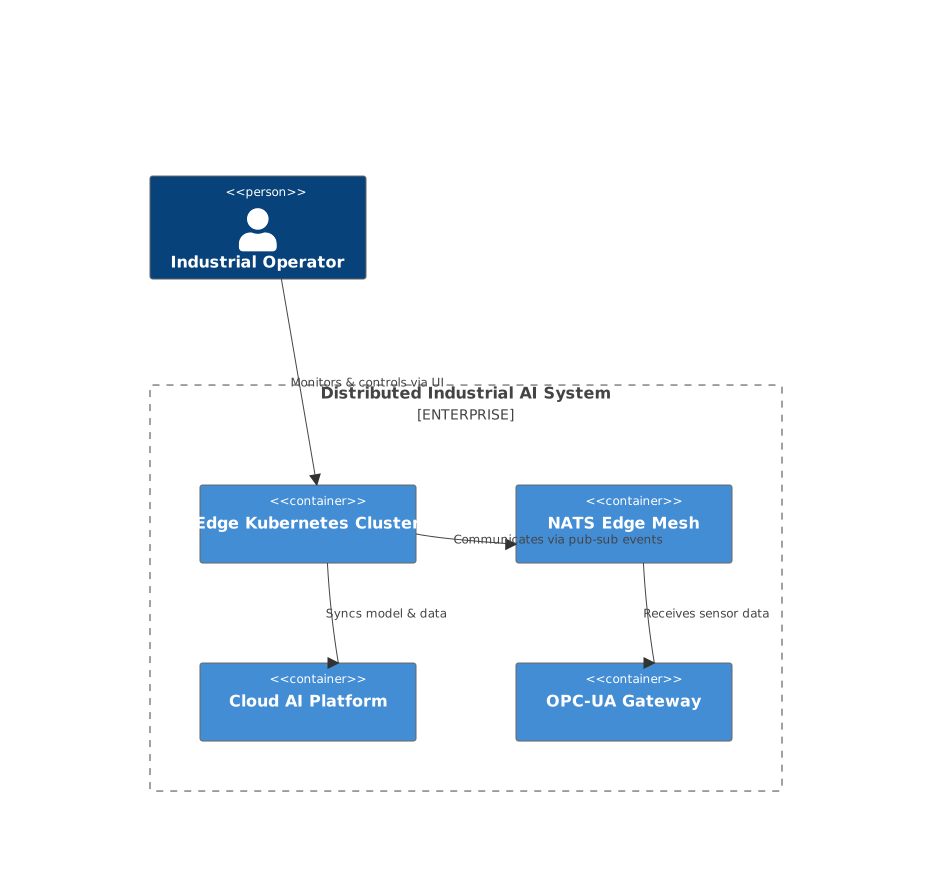
Architecture Recommendations for Enterprise-Grade Distributed Industrial Mesh AI
Design Principles
Enterprises should adhere to these guidelines when architecting distributed industrial mesh networks for AI:
- Embrace Zero-Trust Security: Implement mutual TLS authentication and role-based access control (RBAC) across mesh communication channels. Employ network segmentation between IT and OT environments to reduce attack surfaces.
- Enable Scalable Event Streaming: Use message brokers like NATS JetStream with built-in persistence, replay, and high-availability clustering to ensure resilient data flows.
- Leverage Hybrid Cloud Management: Centralized management consoles should orchestrate edge clusters and enforce global policies for compliance and governance.
- Automate MLOps and Edge AI Lifecycle: Employ CI/CD pipelines and model versioning tools that can continuously deploy updates to edge AI models with minimal downtime.
- Implement Distributed Monitoring & AIOps: Use telemetry from edge nodes integrated into centralized dashboards for anomaly detection, performance tuning, and predictive maintenance.
Architectural Diagram Concepts
A recommended deployment includes:
- Edge Kubernetes clusters hosting containerized AI microservices
- NATS cluster deployed as an edge mesh broker communicating node-to-node
- Secure gateway bridging edge mesh with cloud AI management plane
- Integration adapters for legacy industrial systems
Organizational Impact
Successful adoption requires:
- Skilled multidisciplinary teams blending OT, AI, and cloud-native devops expertise
- Training programs to bridge gaps between traditional industrial operators and software engineers
- Strong governance bodies overseeing security, compliance, and ethical AI usage
Following these patterns enables resilient, low-latency, and compliant AI ecosystems that maximize industrial automation value while meeting enterprise requirements.
References:
- AWS Machine Learning Blogs (https://aws.amazon.com/blogs/machine-learning/)
- Azure AI governance and architecture docs (https://learn.microsoft.com/en-us/azure/architecture/framework/governance/azure-security)
- Forrester and Gartner reports on Enterprise AI governance best practices

Further Reading
- https://www.techtarget.com/searchcio/tip/Top-edge-computing-trends-to-watch-in-2020
- https://cloud.google.com/architecture/ai-ml-infrastructure-patterns
- https://learn.microsoft.com/en-us/azure/architecture/application-architecture/ai
- https://www.cncf.io/blog/2023/04/18/developing-microservices-at-scale-using-cloud-native-mesh-networks/
- https://aws.amazon.com/blogs/machine-learning/
- https://learn.microsoft.com/en-us/azure/architecture/framework/governance/azure-security