AI-Driven Data Center Optimization Architecture
Explore how AI-driven architectures are reshaping enterprise data center management by balancing edge and cloud resources. This post outlines key architectural trends, infrastructure patterns, integration approaches, security and governance considerations, and operational best practices for scalable, efficient AI-enabled data centers.
Introduction and AI Trends in Data Center Optimization
Artificial intelligence is profoundly transforming data center infrastructure management across enterprises. By 2025, emerging AI-driven trends are optimizing workloads between edge and cloud environments to deliver agility, cost efficiency, and performance. Organizations increasingly adopt hybrid AI architectures that integrate on-premises edge capabilities with scalable cloud services, enabling real-time data processing alongside centralized model training and analytics.
These AI-powered optimizations help balance compute loads, dynamically allocate resources, and predict infrastructure failures before they impact operations. Advances in MLOps and AIOps frameworks facilitate automated lifecycle management of AI workloads, from model deployment to continuous monitoring. Containerization and orchestration platforms like Kubernetes are becoming standard tooling, fostering portability and elastic scaling across hybrid environments.
Further accelerating this trend, federated learning and privacy-preserving AI techniques allow enterprises to process sensitive data at the edge while leveraging cloud-scale AI models. This hybrid approach mitigates latency challenges and supports compliance with data sovereignty laws.
The resulting architecture landscape is complex, requiring strategic design decisions to integrate AI systems across heterogeneous infrastructure components, balancing workload distribution, security, and compliance. Understanding these architectural patterns and emerging best practices is crucial for enterprise architects leading AI-driven data center transformation initiatives.
Diagram Concept
A mindmap outlining key areas influencing AI-driven data center optimization: Hybrid AI Architectures, Edge-Cloud Balance, MLOps/AIOps, Container Orchestration, AIEdge Privacy, and Compliance.
AI-Driven Data Center Processes, Data Flows, and System Landscape
Implementing AI to optimize data centers necessitates an integrated ecosystem of compliant data architectures, system integration patterns, and operational processes. Data pipelines ingest high-velocity streams from edge sensors and IoT devices feeding AI inference engines deployed close to data sources, reducing latency. Simultaneously, cloud data lakes aggregate broader datasets for AI model training and business intelligence.
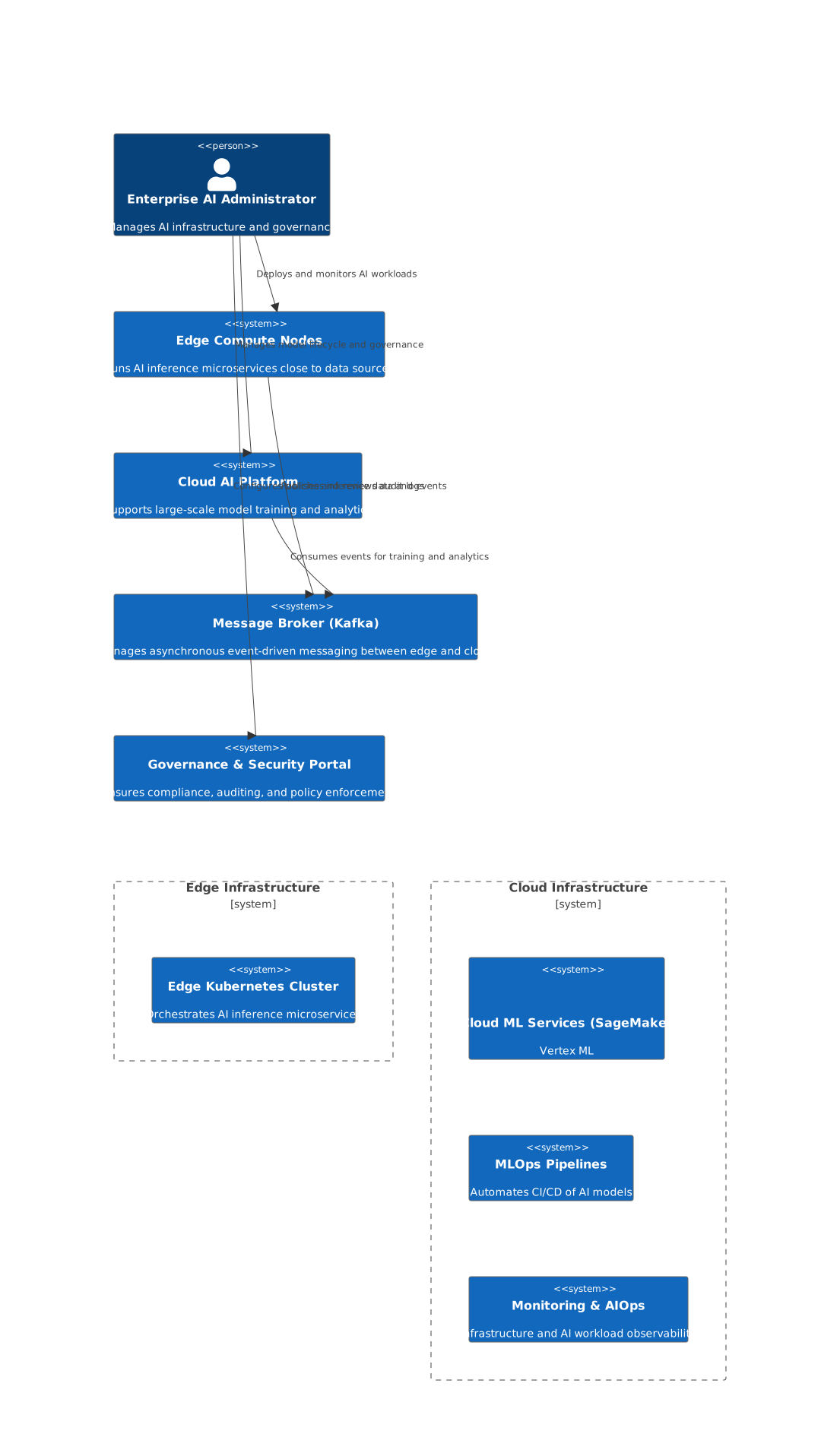
The typical system landscape includes edge compute nodes running containerized AI inference microservices orchestrated by Kubernetes clusters connected via secure, low-latency networks to cloud AI platforms such as AWS SageMaker, Google Vertex AI, or Azure Machine Learning. This hybrid model leverages event-driven architectures using message brokers like Apache Kafka to synchronize data and commands between edge and cloud components.
Security and compliance frameworks underpin this ecosystem. Data governance mandates encryption at rest and in transit, robust identity and access management based on zero-trust principles, and auditable AI model decision trails to ensure transparency and regulatory adherence. AI workloads also require resource optimization mechanisms such as autoscaling based on real-time telemetry from infrastructure performance monitoring tools like Prometheus and AI-specific observability platforms.
Operationalizing AI at scale introduces challenges in versioning, rollback, and reproducibility addressed by MLOps pipelines integrating CI/CD tooling (e.g., Jenkins, GitLab) with specialized model registries and experiment tracking systems (e.g., MLflow, Kubeflow). Cross-functional teams must collaborate effectively, combining DevOps, data engineering, and data science disciplines in an agile development cycle.
Diagram Concept
A C4-model System Context diagram illustrating edge devices, data flow through pipelines and message brokers, Kubernetes-based microservices clusters, cloud AI platforms, and monitoring/security portals supporting operational and governance workflows.
Architecture Recommendations for AI-Driven Data Center Optimization
Hybrid Cloud-Edge AI Infrastructure
Design an architecture combining edge micro data centers with cloud AI platforms to optimize latency and cost. Use container orchestration (Kubernetes) and service meshes (Istio, Linkerd) to manage distributed AI workloads seamlessly. Implement federated learning or differential privacy methods to maintain data privacy across jurisdictions.
Scalable Data and Integration Patterns
Use event-driven microservice patterns with asynchronous messaging (Kafka, RabbitMQ) to decouple edge-cloud interactions. Build unified data lakes with schema registries ensuring semantic interoperability. Automate data validation and cataloging to maintain governance and data quality.
Governance, Security, and Compliance
Adopt zero-trust architecture with fine-grained IAM policies using tools like AWS IAM or Azure AD combined with continuous security posture assessment (using tools like Prisma Cloud, Azure Security Center). Maintain audit logs for AI training and inference decisions to satisfy regulatory bodies (GDPR, CCPA).
Operational Excellence and Lifecycle Management
Deploy comprehensive MLOps toolchains (Kubeflow, MLflow) integrated with CI/CD pipelines enabling automated testing, deployment, and rollback of AI models. Incorporate AIOps platforms leveraging AI for anomaly detection to preempt infrastructure issues. Establish cross-disciplinary teams for continuous monitoring, governance, and iterative improvement.
Organizational Impact
Restructure operational teams to align with data mesh principles enabling domain-focused ownership of data pipelines and AI models. Invest in upskilling in cloud-native AI tooling and data privacy techniques. Emphasize collaboration between infrastructure, security, and AI development teams to navigate architectural complexities and compliance demands effectively.
Diagram Concept
An architecture deployment diagram showing edge Kubernetes clusters running AI inference, cloud AI platforms for training and model registry, integration buses, security gateways enforcing IAM policies, and monitoring stacks employing AI-driven AIOps for proactive maintenance.

Further Reading
- https://www.edgeir.com/how-ai-2025-data-center-trends-impact-edge-computing-20250220
- https://www.mckinsey.com/capabilities/mckinsey-digital/our-insights/the-top-trends-in-tech
- https://www.aws.amazon.com/architecture/data-center-optimization/
- https://cloud.google.com/architecture/operationalizing-ml-pipelines
- https://docs.microsoft.com/en-us/azure/architecture/data-guide/technology-choices/ai-ml
- https://kubernetes.io/docs/concepts/overview/what-is-kubernetes/