Designing Resilient AI Infrastructure Amid Climate Risks
As climate change heightens risks to data centers and networking, enterprises must architect AI infrastructure that is resilient, secure, and compliant. This post explores emerging AI architecture trends, data and system challenges in climate-vulnerable environments, and practical design recommendations to ensure scalability, governance, and operational excellence in hybrid cloud AI deployments.
The AI Infrastructure Landscape and Climate Risk Trends
Enterprise adoption of AI is accelerating rapidly, with architectures increasingly leveraging hybrid cloud, containerization, and orchestration frameworks to meet AI/ML demands. Leading approaches combine cloud-native capabilities with on-premises deployments to optimize latency, security, and cost. The rise of hybrid AI infrastructure facilitates flexible model training, inferencing, and data integration across geographically distributed environments.
However, climate change introduces new vulnerabilities for data center infrastructure, particularly rising sea levels, extreme weather events, and temperature fluctuations, which threaten physical site resilience. Data centers and fiber optic networks located in flood-prone coastal areas or regions with volatile climates face increased risk of downtime or damage.
Recent industry analyses, including insights from Data Center Frontier and AlphaSense, underscore this emerging challenge as a critical trend shaping infrastructure strategy by 2025 and beyond. Enterprises must reevaluate site selection, redundancy planning, and disaster recovery approaches to mitigate climate-induced risks.
Key AI Architecture Trends
- Hybrid and multi-cloud designs: Enabling workload portability and failover across cloud regions and edge sites
- Containerized AI workloads: Leveraging Kubernetes and AI operators (Kubeflow, NVIDIA AI Enterprise) for scalable model lifecycle management
- Integration with real-time data pipelines: Supporting streaming data for dynamic inference
- Strong AI governance frameworks: Incorporating security, privacy, auditability, and regulatory compliance
These patterns are critical in addressing not only performance and scalability but also the resilience requirements driven by environmental uncertainty.
Data and System Landscape Challenges Under Climate Vulnerabilities
AI workloads depend fundamentally on robust data pipelines, storage solutions, and compute infrastructure. Climate risks exacerbate challenges in maintaining availability and data integrity. Enterprises must design data architectures that are both resilient and compliant with data privacy regulations.
Data Architecture Considerations
- Geographically distributed data lakes and replication: Ensuring data redundancy across multiple sites less exposed to climate hazards
- Streaming and batch ingestion flexibility: Using tools like Apache Kafka, Snowflake, or Azure Synapse for real-time and bulk data processing
- Data governance and lineage: Critical for compliance with regulations such as GDPR and CCPA, especially when data crosses jurisdictions due to disaster-driven failovers
AI/ML Infrastructure Components
- Compute resources: Cloud GPUs (NVIDIA A100s), CPUs, and AI accelerators managed via cloud providers or on-prem using Kubernetes
- Orchestration platforms: Kubernetes with AI operators (Kubeflow, Kubeflow Pipelines) standardize model training and deployment
- Networking: High availability fiber networks, sometimes challenged by climate impacts, require redundant paths and failover capabilities
Integration Patterns
- Microservices and APIs: Decouple AI services with RESTful or gRPC APIs to isolate failures and simplify updates
- Event-driven architectures: Use message queues and streaming to handle asynchronous data flows and enable scalable inference
Operational and Monitoring Factors
- Utilize MLOps frameworks (e.g., MLflow, Seldon Core) to automate continuous training and deployment
- Monitor infrastructure resiliency with tools supporting geo-distributed health checks (Datadog, Prometheus with multi-region setups)
The complexity of integrating these components under climate risk demands thorough planning on redundancy, failover, and compliance controls.
Architectural Recommendations for Climate-Resilient Enterprise AI
To architect AI infrastructure capable of withstanding climate threats, enterprises must balance resilience, scalability, security, and operational efficiency.
Multi-Zone and Multi-Region Redundancy
Distribute AI compute and data components across different geographic zones with minimal exposure to the same climate risks. Public cloud providers like AWS, Azure, and Google Cloud offer multi-region availability zones with SLAs designed for fault tolerance.
Hybrid Cloud AI Deployments
Adopt hybrid models where sensitive or latency-critical AI workloads run on-prem or at edge sites, while scalable training or batch processing runs in the cloud. For instance, NVIDIA AI Enterprise on VMware on-prem complements cloud GPU resources.
Containerized and Orchestrated Pipelines
Use Kubernetes-based AI orchestration (Kubeflow, Seldon Core) to enable workload portability and rapid failover. Use GitOps and Infrastructure as Code (IaC) to provision resources consistently across multiple environments.
Security and Compliance
Implement zero-trust architectures and privacy-preserving AI techniques (differential privacy, federated learning) to secure data, especially under distributed deployments. Maintain audit logs aligned with frameworks like NIST and ISO/IEC 27001.
Operational Excellence
- Continuous monitoring with geo-aware alerting
- Cloud cost optimization and auto-scaling to manage resources under shifting demand
- Incident response plans updated for climate-origin disasters
Organizational Impact
- Develop cross-functional teams combining enterprise architects, AI/ML engineers, operations, and disaster recovery experts
- Invest in climate risk awareness and infrastructure training
- Collaborate with cloud vendors and facility managers to ensure alignment on resilience capabilities
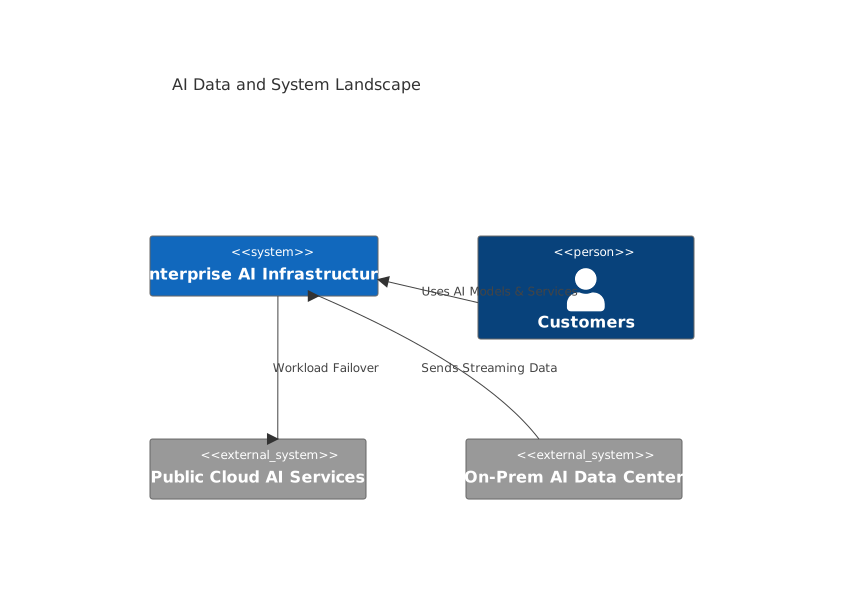
The following diagram exemplifies a resilient hybrid AI architecture leveraging multi-region cloud and on-prem deployments with data replication and failover paths.

Further Reading
- https://www.datacenterfrontier.com/cloud/article/55253151/8-trends-that-will-shape-the-data-center-industry-in-2025
- https://newhybridcloud.cio.com/execute-on-ai-for-real-business-return/a-hybrid-approach-to-ai-ready-infrastructure/
- https://venturebeat.com/ai/cloud-edge-or-on-prem-navigating-the-new-ai-infrastructure-paradigm/
- https://cloud.google.com/learn/what-is-hybrid-cloud
- https://intervision.com/blog-unlocking-the-future-with-hybrid-ai-infrastructure/