Architecting Enterprise AI for Edge Computing Growth
Discover how the rise of decentralized edge computing is reshaping enterprise AI architectures. Learn strategies to design scalable, secure, and compliant AI systems that process real-time data at the edge, leveraging cloud-native, hybrid, and on-premises platforms. Explore integration patterns, operational best practices, and organizational considerations to successfully adopt AI-powered edge solutions.
Introduction and Trend Overview: The Rise of Edge Computing in Enterprise AI
Decentralized edge computing is accelerating rapidly, fueled by AI requirements and an explosion of Industrial IoT applications demanding real-time data processing. As data volume, velocity, and variety grow, traditional centralized AI architectures struggle with latency, bandwidth constraints, and data sovereignty challenges.
In 2024, enterprises increasingly integrate edge compute nodes closer to data sources — such as factories, vehicles, and smart devices — enabling AI inference and decision-making at or near the data origin. This shift is driven by the need for ultra-low latency, privacy preservation, and scalability across widely distributed environments.
Technologies such as containerization (Docker), orchestration (Kubernetes), and cloud-edge hybrid platforms (AWS Outposts, Azure Arc, Google Anthos) form the backbone of modern AI infrastructure enabling edge deployments. Additionally, edge AI requires rethinking data architecture, governance, and operational frameworks to handle heterogeneous environments.
The real impact of this trend is enabling enterprises to unlock insights and automate actions in real-time, transforming industries like manufacturing, retail, healthcare, and autonomous vehicles. However, deploying AI at scale on the edge introduces architectural complexities around integration, security, compliance, and continuous management.
This article explores key architectural patterns, system and integration landscapes, operational models, and governance frameworks essential for enterprise architects to harness the promise of AI-powered edge computing successfully.
Involved Processes, Data, and System Landscapes in Edge AI
AI at the edge introduces unique system design considerations. The data architecture involves a blend of real-time streaming, local data lakes, and eventual synchronization with centralized cloud stores. Pipelines must support data ingestion from edge sensors, preprocessing, AI model inferencing, and feedback loops for model retraining.
Commonly, enterprises adopt microservices and event-driven architectures to build modular, scalable AI systems capable of responding to dynamic edge environments. API gateways and message brokers (e.g., Kafka, MQTT) enable secure and scalable communication between edge nodes and central orchestration layers.
The hybrid cloud-edge topology requires robust identity and access management extending zero-trust principles to distributed nodes. Edge devices typically run containerized AI models to allow portability and rapid updates, managed through MLOps pipelines specialized for constrained environments.
Operationally, monitoring and telemetry frameworks must handle distributed health metrics and inference outcomes, integrated with centralized AIOps platforms to enable proactive issue resolution. Scalability is achieved using auto-scaling mechanisms in cloud components combined with resource-optimized edge deployments.
Data governance frameworks are critical to enforce privacy, compliance, and auditability, especially when processing sensitive personal or industrial data at edge locations. Architectures often embed privacy-preserving techniques like differential privacy and encryption-in-use.
This system landscape requires cross-functional collaboration — combining expertise in AI/ML, cloud and infrastructure engineering, data governance, and security teams — to maintain operational resilience and regulatory alignment.
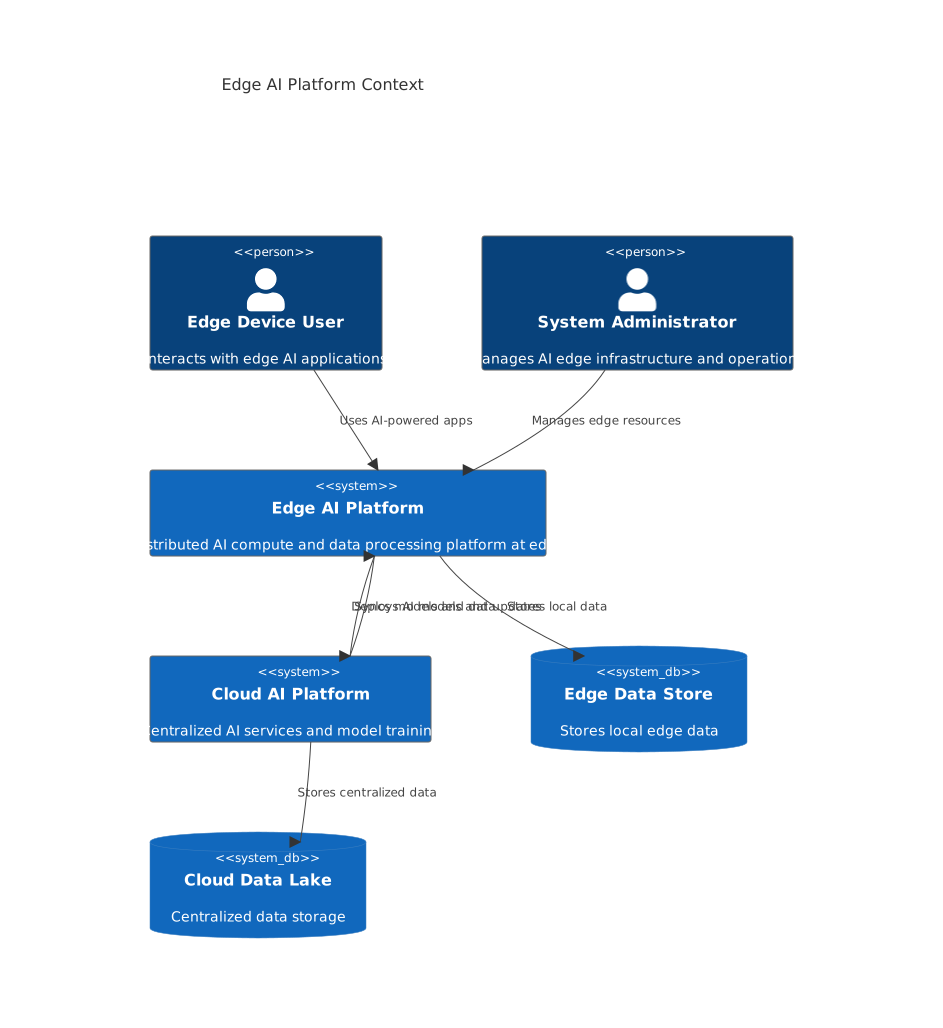
Architecture Recommendations for Enterprise AI Edge Deployments
Adopt Hybrid Cloud-Native Platforms: Use technologies like Kubernetes with distribution via Azure Arc, AWS Outposts, or Google Anthos to unify deployment, management, and governance across cloud and edge nodes.
Leverage Containerization and Orchestration: Containerize AI models and services for interoperability and lifecycle management; orchestrate edge workloads for automated updates and fault tolerance.
Implement Event-Driven & Microservices Patterns: Facilitate loose coupling and asynchronous communication between edge devices and centralized services to enhance scalability and fault isolation.
Enforce Zero-Trust Security Architectures: Extend identity security to every edge node, utilize encrypted communication (TLS, mTLS), and audit all data accesses to ensure compliance and reduce attack surface.
Integrate MLOps & AIOps Pipelines: Develop edge-specific continuous integration/continuous deployment (CI/CD) workflows for AI models with automated monitoring and feedback loops through centralized AIOps dashboards.
Embed Data Privacy & Governance: Deploy privacy-preserving AI techniques and ensure data lineage and audit trails meet industry and regulatory standards (e.g., GDPR, HIPAA).
Plan for Organizational Change: Build cross-disciplinary teams skilled in cloud, AI/ML, security, and operations; formalize governance councils to manage edge AI risk and compliance.
By addressing these recommendations, enterprise architects can build resilient, performant, and compliant AI systems at the edge that scale with evolving business needs.
Architectural Diagram Concept: The deployment architecture visualizing hybrid cloud-edge clusters running containerized AI models, connected via API gateways and secured with zero-trust identity management, monitored by unified MLOps and AIOps frameworks.
